 TRIDENT
Trident Retrofit
Nothing goes to site until the home is ready.
Trident is the back office for funded retrofit. It checks each home against the paperwork it needs before anyone books a van, and checks the evidence again before the home goes to your client.
It works the same whether your own crews do the work or you pass it to a supply chain. If you're the principal contractor, start here.
What it doesn't do: Trident doesn't write PAS 2035 assessments or replace your retrofit coordinator. It reads and checks their work against each home. Lodgement with TrustMark still goes through your own lodgement route. I'd rather tell you now than on day three. Steven Hassall, who built it

Retrofit is now paid on evidence
In October 2025 the National Audit Office reported that 98% of external wall insulation homes under ECO4 and GBIS are believed to have major issues needing remediation. Putting it right costs £5,000 to £18,000 a home if it's caught before damage occurs.
The rules have tightened since:
- Photos must be date and time stamped, geotagged and taken at the right stage. A blurred serial number means a return visit.
- TrustMark gives eight weeks to fix a non-compliance. On ECO4 and GBIS work inspected since June 2026 there are no extensions. Since 13 July 2026, closing one needs a video walkaround.
- The government has consulted on its own data system to target audits, and on a public register of installers.
- Your main contractor won't pay for a home until its evidence is complete, and your client won't pay them.
ECO4 ends on 31 December 2026 with no successor obligation, and the money moves to the Warm Homes Plan. The firms that can show their quality home by home will be best placed for that work.
Sources: National Audit Office, October 2025 · TrustMark quality assurance · ECO4 end date, GOV.UK · DESNZ consultation, 2026
How a home moves through Trident
Each home goes through the same steps, in order. If something is missing, Trident says what it is and who owes it, and the home waits.
- Home in Contract, measures and client documents loaded
- Stage 1 Assessment, coordination, IOE, asbestos, ventilation, floor plan
- Release gate Holds if any Stage 1 document is missing or unchecked
- Booked and installed Crews and scaffold in one diary; evidence from Trident Field
- Evidence gate Holds if a photo, certificate or form your client needs is missing
- Client and paid Valuation, claimed-and-paid matched home by home
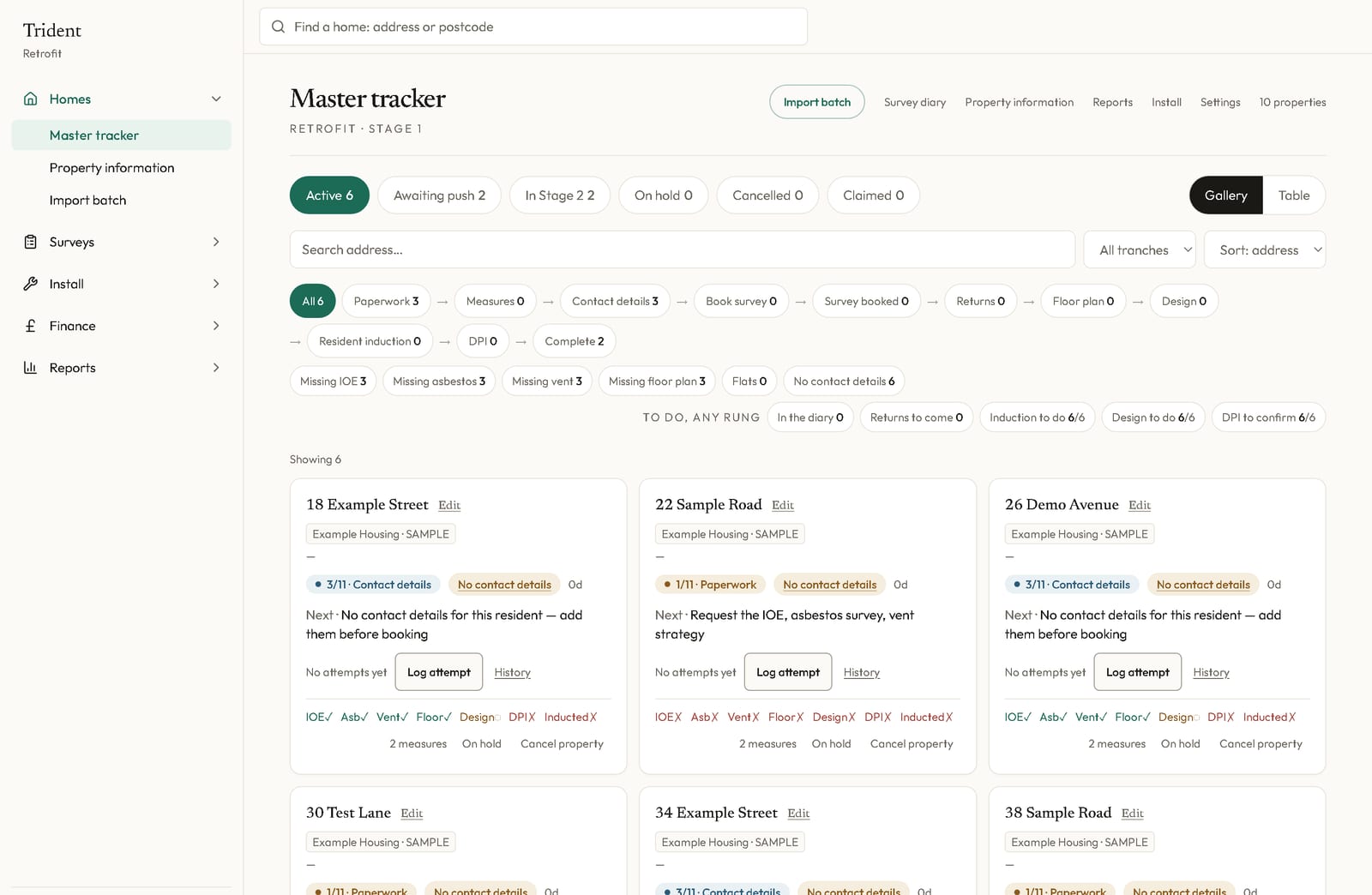
Try the release gate
This is how a held home looks in Trident. Tick the missing documents in as they arrive, or press Release before they have.
14 Example Street
Run a whole home through Trident, office and phone
Step by step
- Paperwork in. Contract details, measures and the client's documents are loaded. Duplicates are caught on the way in.
- Surveys booked and back. Retrofit assessment, coordination, ventilation, IOE, asbestos survey and floor plan. Trident reads the PDFs and pulls out the figures your team would otherwise type in. Each figure keeps the line it came from. Anything it isn't sure of goes to a person.
- Design and resident. Measures confirmed, design released, resident contacted and inducted. Where solar PV is in the mix, Trident draws the first panel layout from the address for a designer to check.
- Released to install. A person in your office releases the home. Without its IOE, asbestos survey or ventilation assessment on file it can't be released at all. Overriding any other rule needs a name and a reason, and it's logged.
- Booked. Surveys, crews and scaffolders go in one diary. A scaffold can't go up without its permit, and each one is tracked to strike so you know who's still being billed. Jobs don't start at the weekend. Your client gets a weekly booking sheet in Excel.
- Installed and evidenced. Photos, forms and certificates from every visit land on the home they belong to. Extra work found on site is raised as a variation with photos.
- Checked and paid. The evidence is checked against what your client needs. Variations are priced from your rate card and approved within the limits you set for each role. Valuations and the claimed-and-paid match show which homes are still owed. Your client has a page showing which homes are waiting on them, so there are fewer "where are we on…" calls.
For principal contractors
When you hold the contract, the subcontractor's mistake is yours
A job goes ahead without its asbestos survey. A home goes to the client with half its photos. A variation nobody saw turns up in the final account. Trident is built to stop those at the point they happen.
- Stage 1 is checked before anyone is instructed
- Assessment, coordination, ventilation, IOE and asbestos survey are in and checked before a home can be released to a delivery partner.
- Each contractor sees their own homes
- A delivery partner sees only the homes you've released to them. Their site teams capture evidence in Trident Field, and it lands on the home in your system.
- Their work is checked on the way back
- Photos, certificates and forms are checked against what your client needs before the home moves on, so you aren't re-checking it yourself.
- You can see who's holding what
- Which homes are waiting, on which contractor, and for how many days.
- Less for the QS to do by hand
- Progress is recorded against the programme. The valuation is laid out like a bill of quantities. Variations are priced from your rates. Claimed-and-paid is matched home by home, with your client's reference and PO on every line.
- Set up per contract
- Stages, gates, forms, rates and money limits are settings for each contract, done in Trident's admin screens. I'm happy to talk about what you'd want next, such as matching supplier invoices or writing subcontract orders from your rates. They would be built on the same records.
Built to run a whole programme
Trident started from the rules a programme has to follow, and the screens came after. That's why it holds up when the volume goes up. Use it for one contract or many, a few homes or a framework, and add contracts, clients, contractors and users as the work grows.
Each contract has its own gates, forms, rate cards, money limits and documents. Every change on every home records who made it, when and why, so an audit is a matter of reviewing what's already there.
A UK retrofit contractor has run its funded programmes on Trident every working day since July 2026, across several contracts and clients. Ask me about it in the demo.
The other parts of Trident
Trident has three parts that share the same records. Start with the one you need.
- Trident Retrofit is the office system. It holds every home, every booking and every document, and checks each home is ready before it moves on.
- Trident Field is the phone app for the people on site. What they capture lands straight on the right home in Retrofit, so the office sees evidence the moment it's sent.
- Trident Solar is the design engine. It is the same engine that designs solar inside Retrofit, so a retrofit contractor gets solar design as part of the programme, and a solar installer can use Solar on its own.
Where your data lives
- Staff sign in with their own company Microsoft accounts, so every action has a real name on it.
- Hosted in London, with nightly backups kept for 30 days and a restore we've tested.
- Documents are held in a private store and opened through short-lived links.
- Valuations, billing lists and claims export to Excel for your accounts system.
- Ready-made forms for loft insulation, solar PV, ventilation and roof work, and you can add your own.
See it on a real programme
Thirty minutes on Teams. I'll walk a home from survey to handover on a live programme and show you what your office would see on a Monday morning.
If you go ahead, I load your contracts, forms and rate cards for you.
Or ring me, Steven Hassall, on 07807 025270. I built Trident and I'll be the one on the call. Email works too: hello@trident-os.com.
If it isn't right for how you work, I'll tell you.